Jinn-Ginnaye is a practice research project developed alongside and beyond the live Choreomusical performance, Jinn. It consists of a collection of connected, but discrete pieces exploring issues surrounding western dance performance in Islamic cultures, where modesty laws restrict depictions of the human body in public. Jinn-Ginnaye approaches these restrictions as creative constraints, exploring how emergent digital arts techniques can be used to remove the body of the dancer, but leave behind the dance, and the traces of the desert in which it was created.
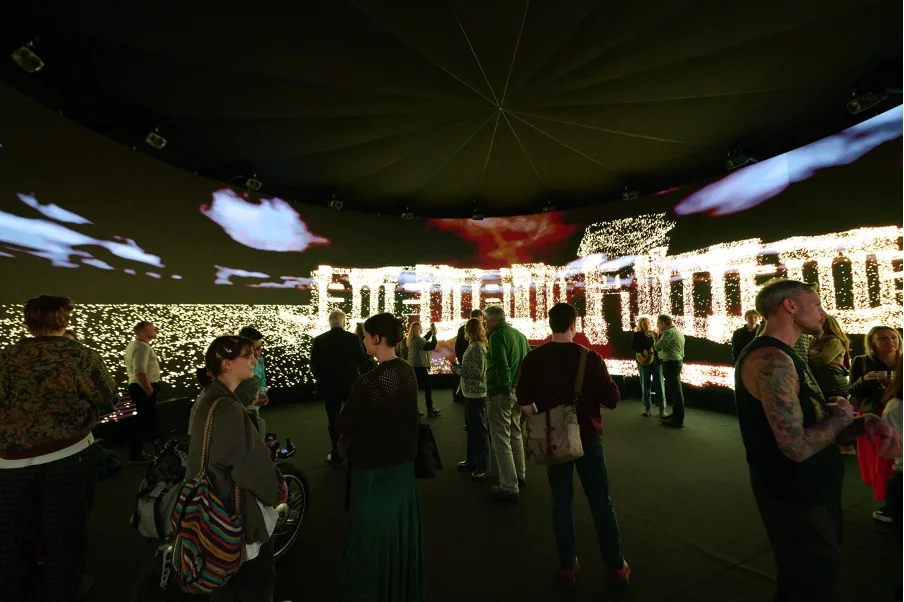
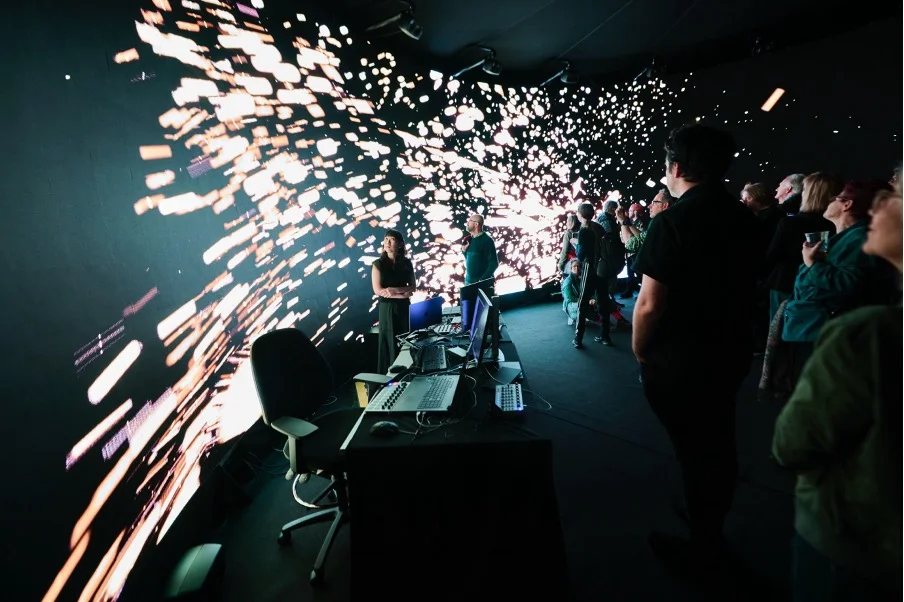
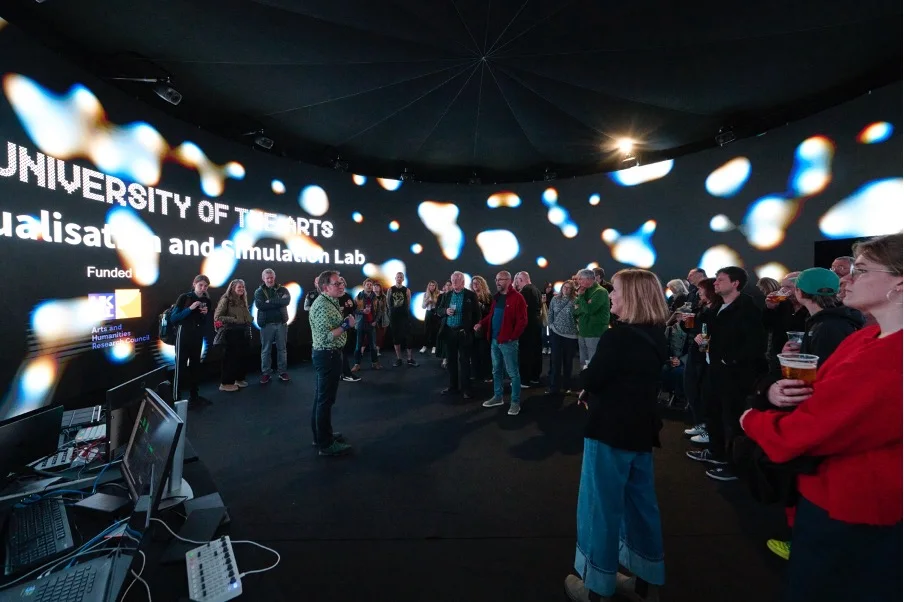
Jinn was devised as an internationally touring 60-minute proscenium dance performance. Jinn-Ginnaye explores how digital assets created for Jinn (including audio recordings, motion capture data, 360 images, virtual sets), can be re-combined and expanded to create new methods of experiencing the performance. This output explores new capabilities for bringing an audience of up to 70 people into a shared immersive space through Norwich University of the Arts’ Immersive Visualisation and Simulation Lab.
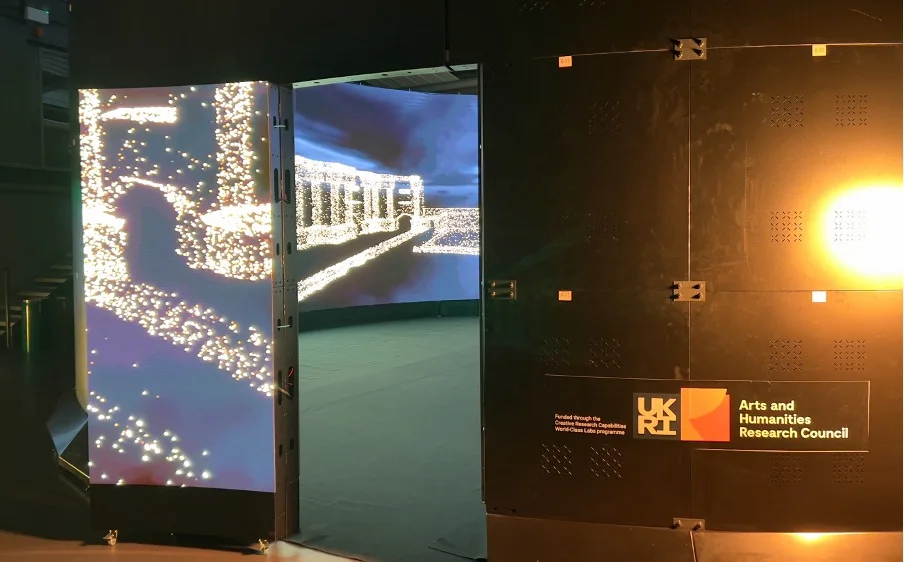
The new works in this portfolio have been created since 2024 and explore the link between Jinn and the Ginnaye of Palmyra, from which we have derived the term, Genius Loci, or spirit of a place. This version connects to the desert architecture used to host an orchestral concert for Vladimir Putin, just months after it was used by ISIS for a performance of the mass execution of 25 prisoners.
The research process
The core research question behind Jinn-Ginnaye has been, “can immersive media be used to present Western Dance performance in a Muslim country, while respecting Islamic culture and traditions?” Secondary questions ask how the experience of being in a desert can be evoked through sound, and how performances can be extended through immersive tools and technologies.
Impetus for Jinn-Ginnaye came from experiences of censorship when the International Symposium on Electronic Art (ISEA) was held in Dubai in 2014, when all images of women’s bodies were removed from public presentations. Jinn-Ginnaye asks how the constraints of Islamic Culture can lead to new forms of creation and expression, and how we can present Dance, without a dancer.
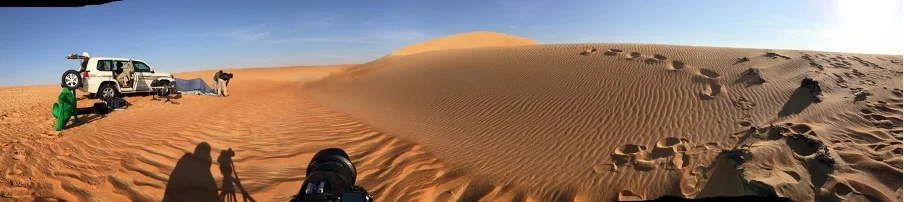
The Jinn project explored methods of capturing the sound of wind across dunes and how forms and densities of sand create different sounds as they are walked through. Woolford had collaborated with NYU Associate Professor Carlos Guedes for more than a decade, including on the AHRC-funded Motion in Place Platform, where Woolford (as PI) explored methods of motion capture “in the wild” (AH/H037675/1). Woolford created a “sand dancer” based on local legends of Jinn, and spent 4 years experimenting with VR, AR, and immersive methods to place audience members in the desert with the dancer.
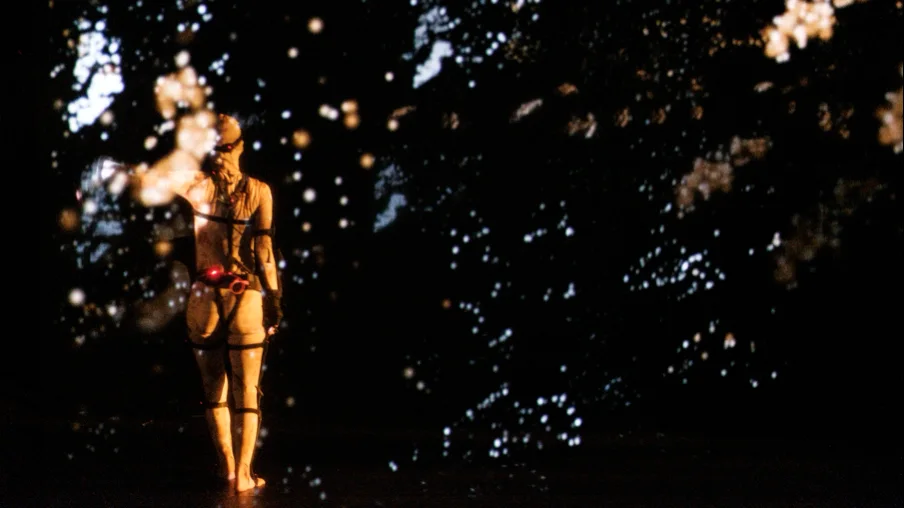
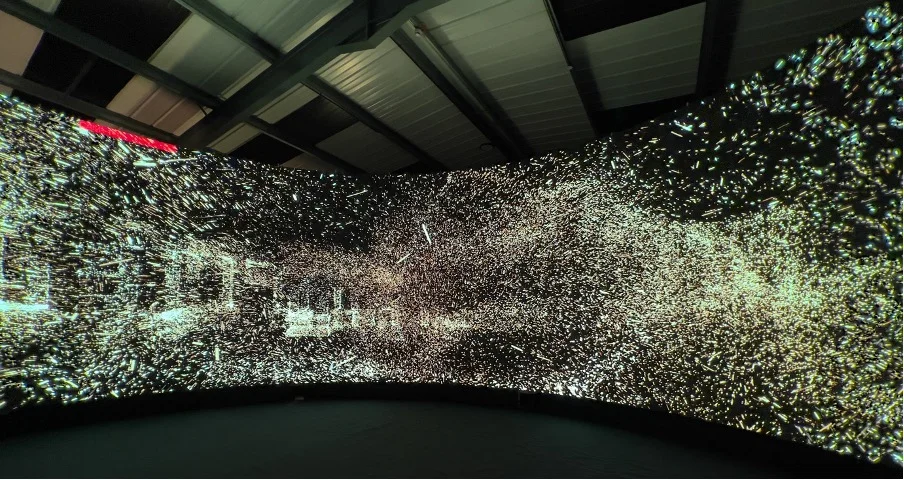
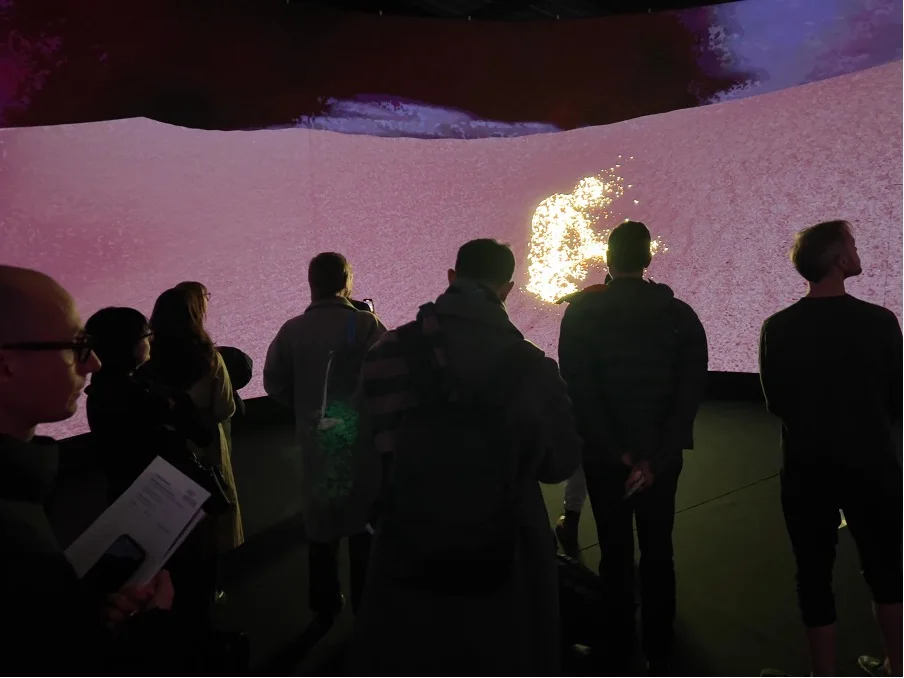
Jinn Ginnaye: Palmyra explores the concept of the Islamic Jinn or مَارِجٍ مِن نَّار and their link to an older Aramaic term “ginnaye” linked to the city of Palmyra, and sharing the same root as the Greek “Genius Loci”, or spirit of a place. Jinn Ginnaye: Palmyra explores the past history of Palmyra as trading post and meeting place between East and West. It also explores the use of new immersive techniques to create responsive environments enclosing an audience within a space of swirling sound and sand, before forming into the desert architecture used to host an orchestral concert for Vladimir Putin, just months after it was used by ISIS for a performance of the mass execution of 25 prisoners and before ISIS attempted to completely destroy the site and erase its history.
Insights
Insights from the work can be divided under two headings:
Cultural
- The work functions as a meeting place for discussion between Islamic and Western cultures. It has been surprising for Islamic colleagues to see a work exploring their traditions and attempting to address their histories in a respectful manner.
- The project’s exploration of dis-embodied movement has been discussed at Dance conferences.
Technical
- The expansion of the work has pushed development of Norwich University of the Arts’ Immersive Visualisation and Simulation Lab. The project required the development of completely new forms of 360 virtual cameras within Epic’s Unreal Engine. This virtual camera is the result of work from 6 programmers and 2 AI agents. It is in the process of being shared with Epic to become a tool within Unreal Engine, and distributed worldwide.
Presentations
Jinn Ginnaye: Palmyra was first presented to the public in November 2024 during the Architectural Humanities Research Association’s 21st International Conference, “Body Matters”. A subsequent version was presented to public, and paying audiences during the Norfolk and Norwich Festival (May, 2025).
Shown at the Norfolk and Norwich Festival, May 2025
Development of Jinn/Ginnaye practice outputs were disrupted by the closure of the Digital Media Arts programmes at the University of Surrey in 2019, followed by constraints on live gatherings during the Covid-19 lockdowns of 2020-2021. During this period, Jinn/Ginnaye work-in-progress was presented virtually at events including the Modes of Capture Symposium, Dublin Dance Festival & University of Limerick (2021) and the Wrong Biennale’s, “One more time with feeling”, which was exhibited in 143 pavilions and embassies and elected top ten art exhibition of the year by Artforum (2021-22).
Earlier developmental versions of Jinn and Jinn-Ginnaye were presented at the following events:
- Woolford, K. (Jul 2017), “Jinn-Ginnaye”, 2017 International Workshop on Movement and Computing (MOCO ’17), Goldsmiths, University of London. Motion capture site-specific VR/AR installation, University of Surrey.
- Guedes, C., Woolford, K. (2018), “Jinn”, Festival Internacional de Marionetas do Porto 2018 (International Puppetry Festival), Rivoli National Theatre, Porto, Portugal.
- Guedes, C., Woolford, K., et al. (Oct 2018), “Jinn”, The Arts Centre at NYU Abu Dhabi, New York University Abu Dhabi. Live music and dance performances.